




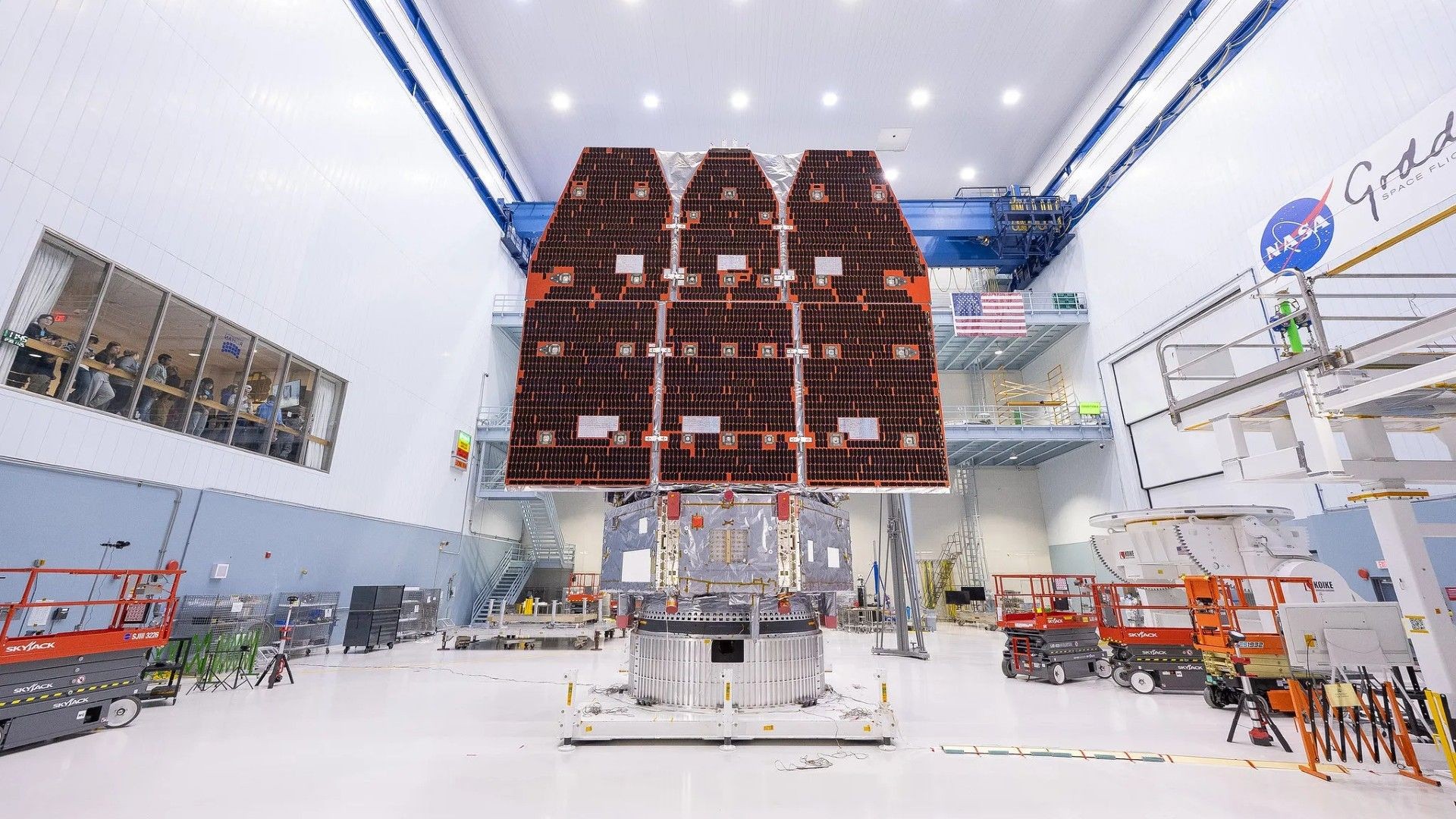
NASA is preparing to pull back the curtain on its next major leap in space exploration. On Tuesday, April 21, at 4 p.m. EDT, the agency will host a special briefing to introduce the Nancy Grace Roman Space Telescope, a next-generation observatory designed to map the vast complexities of our universe.
The Mission Roadmap: From Maryland to the Stars
The announcement will take place at NASA’s Goddard Spaceflight Center in Greenbelt, Maryland—the very site where the telescope was constructed. The briefing will feature key leadership, including NASA Administrator Jared Isaacman and senior project scientists, to discuss the mission’s scientific objectives and technical progress.
The telescope is currently nearing the end of its rigorous pre-launch testing phase. Once finalized, it will be transported to the Kennedy Space Center in Florida for its final journey. The Roman Space Telescope is slated to launch aboard a SpaceX Falcon Heavy rocket, with a launch window spanning from autumn 2026 to May 2027.
A Wide-Angle View of the Universe
While many famous telescopes are known for their ability to zoom in on specific, distant objects, the Roman Space Telescope is built for breadth.
Though it features a 2.4-meter mirror—comparable in size to the legendary Hubble Space Telescope—its capabilities are fundamentally different:
– Hubble acts like a high-powered microscope, focusing on fine, intricate details of specific celestial bodies.
– Roman acts like a wide-angle lens, capable of surveying the sky with a field of view 100 times larger than Hubble’s.
This massive field of view is critical for studying the “big picture.” By capturing vast swaths of the sky at once, Roman will help astronomers investigate the large-scale structures of galaxies and stars, providing vital data on the mysterious forces of dark matter and dark energy that govern the expansion of our universe.
Hunting for Worlds via Gravitational Lensing
Beyond mapping the cosmos, Roman will turn its gaze toward our own Milky Way to search for exoplanets through a specialized “Galactic Bulge Time-Domain Survey.”
To find these distant worlds, the telescope will utilize a phenomenon known as gravitational lensing. Based on the principles of general relativity, this occurs when the gravity of a massive object bends the light from a more distant source. As a planet passes in front of a star, it creates a subtle flicker or distortion in the starlight. By detecting these tiny “glitches” in light, Roman can identify planets that might otherwise remain invisible to traditional observation methods.
Summary: The Nancy Grace Roman Space Telescope represents a shift from detailed observation to massive-scale surveying. By combining a wide field of view with advanced gravitational lensing techniques, NASA aims to solve the mysteries of dark energy and uncover the hidden population of planets within our galaxy.