


We might need to rewrite the first chapter of life on Earth. Again.
New 567-million-year-old rocks from Canada suggest complex animals appeared earlier than we thought. And not just a little bit earlier. Way earlier.
For a long time, the story went something like this. Simple stuff first. Then a bang. The Cambrian Explosion. Suddenly, all the basic animal groups showed up. Butterflies, whales, worms. You name it. Before that? The Ediacaran period. A quiet time, supposedly. A nursery.
That narrative just cracked.
“The story of Earth’s first animals… adds crucial information.”
Actually, it rewrites it.
The Ediacarian Puzzle
Let’s look at the players.
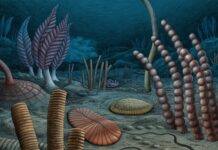
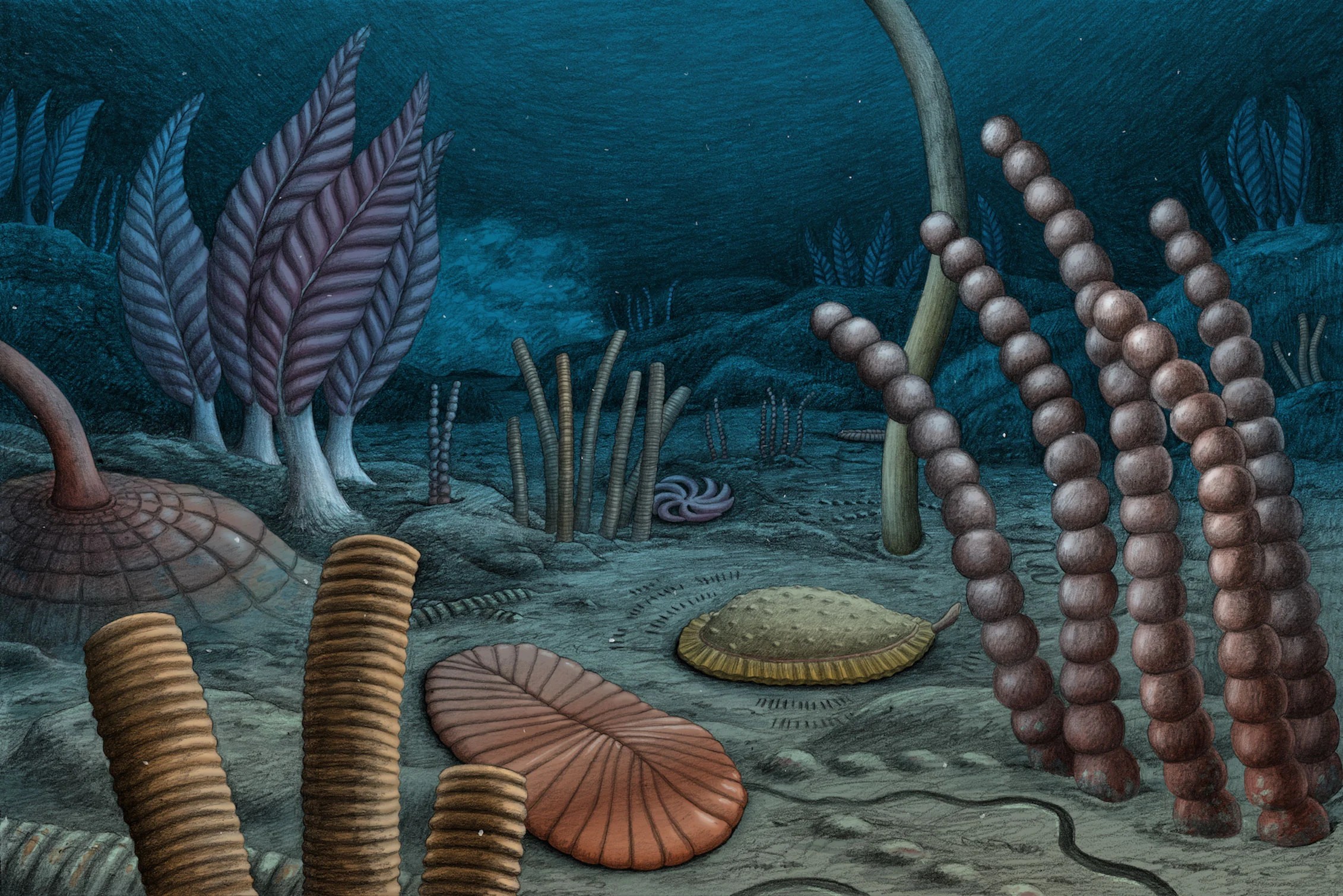
Between 635 and 538 million years back, the seafloor held weirdos. Soft-bodied things. Some looked like pancakes. Others like soft tubes pressing into mud. We call these the Ediacarans.
Here’s the big debate. Were they our ancestors? Or evolutionary dead-ends? Failed experiments?
Paleontologists split them into three “chapters” based on when and where they lived:
1. Avalon: The old stuff. Deep water. Simple forms.
2. White Sea: The middle stuff. Bigger. Diverse. Including Dickinsonia. That ribbed, oval guy. Looked like a quilted placemat, really.
3. Nama: The new stuff. Shells started showing up. Hard parts.
The accepted timeline? Avalon fades. White Sea begins around 560-550 million years ago in shallow waters.
Yeah. That part is probably wrong.
Deep Water, Wrong Place
Scott Evans and his team did what good paleontologists do. They went digging. Specifically, the Mackenzie Mountains in Canada. Remote. Cold. Great for hiding secrets.
They found fossils there. Frond-like bodies. Segmented shapes. Things that look exactly like White Sea assemblage creatures.
Problem is.
Those White Sea critters were supposed to live in shallow, warm coastal zones. The Canadian rocks? Deep water slope environments. Far out. Near Laurentia (the ancient chunk of land that became North America).
And the date?
567-566 million years old.
Seven million years before the “classic” White Sea timeline. Seven million years is nothing in geologic time, sure. But for early evolution? It’s a huge deal.
A Blur, Not a Line
This changes everything.
First, geography. These animals weren’t stuck in one corner. They spread across Laurentia. They reached deep oceans.
Second, timing. The White Sea-style community existed way earlier than the famous sites in Russia or Australia.
Third, environment.
Environments help shape life.
We always assumed the shallow waters were the incubator. The warm, safe spots. But maybe not.
These deep-water fossils suggest the opposite. Maybe the deep ocean was the cradle. Stable. Quiet. A place to experiment before crashing into the shallow surf.
The boundary between Avalon and White Sea isn’t a line. It’s a blur.
The new findings suggest overlap. Avalon-style fronds and White Sea-style animals? Living together. In the dark. Deep down.
So, was the Ediacaran to Cambrian transition a sudden explosion? A switch flip?
Probably not.
It looks more gradual. Messy. Ecological expansion. Animals testing shapes. Trying movements. Seeing what worked on the mud floor.
Evolution Solves Problems
Think of evolution as problem-solving.
Soft body in shallow water? You get tossed around by waves. Sediment shifts. Light hits your eyes. Big challenges.
Soft body in deep water? Calmer. Different challenges. Pressure. Darkness. Food falling from above like snow.
Different problems breed different solutions. Or do they?
That’s convergent evolution. Birds and bats. Totally unrelated. Same problem: get airborne. Same solution: wings.
Maybe the same broad solutions—tubes, fronds, flattened sheets—were tried over and over again. Repeatedly. As life tested the limits of the seafloor.
We’re used to thinking of evolution as a tree branching out. Maybe it’s more of a mesh. Repeating patterns. Testing grounds.
The Canadian fossils show us that the “chapters” weren’t written in ink. They were written in sand.
And the tide is still changing.