



We know bees for honey and pollination. They are indispensable to many plants. But that is not everything. Bees show surprising mental abilities. They have a fantastic sense of direction. They use medicine to fight parasites. They can even do math. They deserve celebration on World Bee Day.
The Threat to Bee Habitats
Bees have a hard time. Humans destroy their habitats. Cities grow bigger. Intensive agriculture takes over land. Food plants become rare. Pesticides harm their health. These chemicals also damage their orientation skills. If bees vanished, it would be more than the end of honey sandwiches. Many plants would suffer too. Wind and rain move some pollen. But bees carry pollen from flower to flower. They secure plant reproduction. We need to look closer at these important insects.
The Dance of Communication
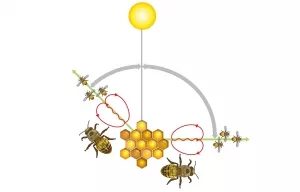
Some wild bees live alone. Social bees like bumblebees and honeybees live in large colonies. They work together in hives. The hive functions like a well-oiled machine. Small gears work together. When a collector bee wakes up in the comb, she gets instructions. Scout bees give them first. These scouts found the best nectar spots for the day.
The instruction happens through a complex dance language. Bees use it to communicate. They perform round dances or waggle dances. They vibrate their abdomens. This tells sisters exactly where food is. It also shows how rich the source is. The instructions help the collector bee. She is ready for her flight. She heads to the nectar source.

How bees use tiny brains for complex math and navigation
You might assume that navigating a landscape and solving basic arithmetic requires a substantial brain. Yet, the honey bee manages both with an organ no bigger than a cubic millimeter. It is not just instinct. It is complex, efficient wiring.
The journey begins with orientation. When a forager leaves the hive, she relies on a sophisticated sensory toolkit. Her large compound eyes provide a panoramic view of the terrain. She picks out landmarks. But the real magic happens with ultraviolet light. Humans cannot see it. Bees can. Even on cloudy days, that UV spectrum offers a navigational grid. They hold an internal map relative to their home.
Smell plays a role too. Researchers at the University of Giessen found that bees can detect individual scent molecules. Their olfactory acuity actually outperforms that of scent hounds. This combination of vision, UV perception, and smell allows them to chart the most direct route between flowers and the hive.
Can insects really do math?
Processing all this sensory data demands significant cognitive effort. The bee’s brain contains roughly one million neurons. That is a small number compared to humans, but the connections are dense. This density enables abilities we rarely associate with insects.
They can count. More surprisingly, they grasp the abstract concept of zero. In experiments, bees were shown images with varying numbers of dots. They learned that an empty image represented a value lower than one with dots. This is a difficult cognitive leap. Human children typically do not understand zero until they are about four years old. Bees get it immediately.
The math goes further. Some species have been trained to perform simple addition and subtraction. Scientists used color codes to teach this. Blue meant add one. Yellow meant subtract one. A bee might see three yellow squares. The correct answer is two. The bee must choose between a panel with four squares and one with two. The bees learned the rules quickly. They flew to the correct solution repeatedly.
Why does this matter?
This raises a practical question. Why would a bee need to do subtraction? Biologists suspect it helps in foraging decisions. Flowers have different traits. Some signal high nectar. Others do not. Being able to weigh these features quickly could mean the difference between a successful harvest and a wasted trip.
The mechanism remains a mystery. How does such a small brain handle abstract symbols and arithmetic? We know they can do it. We do not yet fully understand how. The efficiency of their neural network suggests that intelligence does not always require size. It requires the right architecture. And that architecture is still being decoded.

Honeybees are not just hardworking laborers. They are a collective with a surprisingly robust immune system. One of their most effective defenses is a behavior known as bee self-medication. When the hive is under attack by Varroa destructor, the blood-sucking mite that plagues colonies worldwide, the bees don’t just wait to die. They act.
The response is specific. Bees increase their collection of propolis, the sticky tree resin they gather from budding trees. Instead of just using it for construction, they coat the interior walls of the hive with it. Why? Because propolis is antimicrobial. It is toxic to the Varroa mites. By lining the hive with this resin, the bees create a chemical barrier that limits the spread of the parasite. It is a form of prophylactic medicine for the entire colony.
But what happens when an individual bee gets sick? The mechanism is different here. It is behavioral isolation.
Sick bees often suffer from neurological damage. The infection disrupts their orientation. They forget how to find their way back to the hive. While this sounds tragic for the individual, it is a strategic advantage for the group. By staying away, the sick bee prevents the transmission of pathogens to the rest of the colony. It is essentially an ancient, instinctual form of social distancing. The bee dies alone. The hive survives.


