Some stars are exploding for reasons we barely understand.
New research suggests an invisible intruder is pulling the trigger.
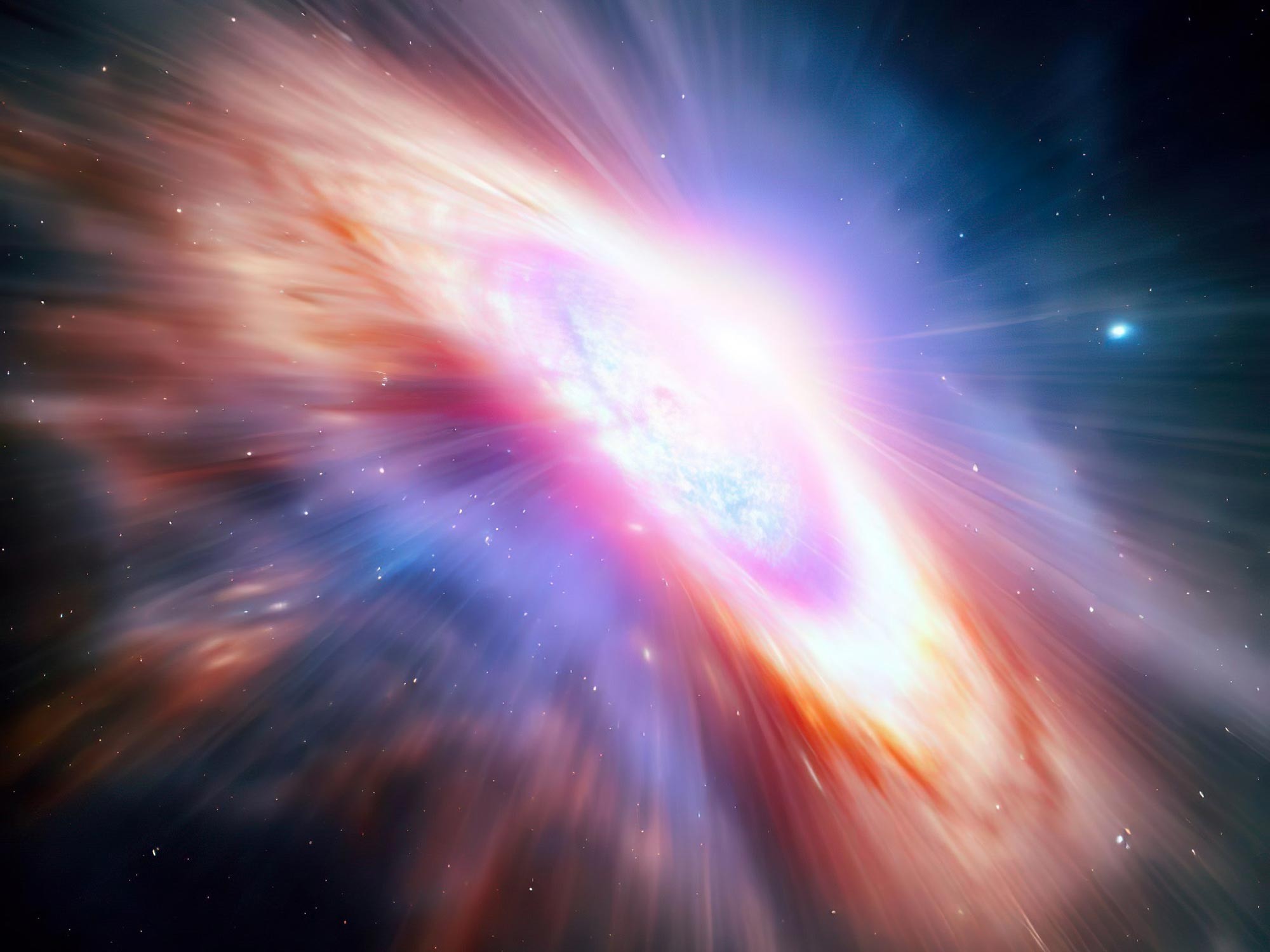
An international team has found that primordial black holes (PBHs) could ignite white dwarf stars. This mechanism turns standard Type Ia supernovae into something else entirely. Or perhaps something familiar, just triggered by the unexpected.
The findings, published in The Astrophysical Journal, offer a solution to a lingering chemical mystery. The Milky Way’s composition doesn’t match standard models. Unless these ghostly black holes are involved.
What are Primordial Black Holes?
They aren’t the kind you find at the end of a galaxy.
PBHs are hypothetical remnants from the early universe. They formed from matter fluctuations during cosmic inflation, shortly after the Big Bang.
Scientists consider them candidates for dark matter. The unseen stuff that makes up 90% of the mass in the cosmos. We can’t see them. But we know they might be there.
And they might be passing through stars right now.
When a PBH travels through space, it can pass through a star. The gravity creates intense tidal forces. In the case of a white dwarf—the dense, Earth-sized corpse of a low-mass star—these forces could be catastrophic.
The pressure spikes. The nuclear fusion ignites uncontrollably. Boom. A Type Ia supernova.
Checking the Chemical Footprints
Shing-Chi Leung led this investigation. He’s an assistant professor at SUNY Polytechnice Institute and a visiting associate scientist at the Kavli Institute for the Physics and Math of the Universe. He worked with Ken’ichi Nomoto, Alexander Kusenko, and Tomoharu Suzuki.
They didn’t just theorize. They compared models to reality.
Which supernovae fit this profile?
The team looked at remnants like Tycho, Kepler, and 3G 397. They studied nearby explosions, including SN 2011fe SN 2012cg, and older events.
The results were striking. PBH-triggered explosions closely resembled standard Type Ia supernovae in terms of light and motion. That’s a problem for observers. How do we tell them apart?
By looking at the leftovers.
The researchers analyzed chemical abundances in these remnants and across the galaxy. They focused on radioactive isotopes like Ni-56 and Ni-56, plus stable elements like Mn and Ni.
“Our work suggests that some supernovae that the sky could be result of PBHs… they leave many interesting clues in nature.”
— Shing-Chi Leung
These isotopes act as tracers. They reveal the mass and metallicity of the white dwarf that exploded. Metallicity here means the amount of heavier elements present when the star formed. It’s a clock. A way to trace cosmic history.
The Galaxy’s Missing Ingredient
Here’s where it gets specific.
The Milky Way’s chemical enrichment patterns didn’t make sense with standard models alone. Stars showed abundance trends that couldn’t be explained by conventional supernova rates.
But when the researchers modeled a non-zero fraction of PBH-triggered Type Ia supernovae, the math clicked.
The galaxy’s chemistry finally aligned.
A portion of these stellar explosions must be caused by these invisible objects. Even if we can’t see the black holes themselves, their impact is written in the stars.
Why This Matters
This isn’t just about fixing a chemical imbalance. It’s about expanding our view of the universe.
If PBHs exist—and this research strengthens that case—they aren’t just dark matter. They are active participants in cosmic evolution. They shape the chemical makeup of galaxies. They influence which stars survive and which explode.
The team plans to dig deeper. Next, they want to understand how PBH-triggered events affect the overall population of supernovae. What are the combined rates? How often does this happen compared to the standard models?
We still don’t have a direct detection. We are inferring their presence from the scars they leave on dying stars.
But the scars are real. The chemical fingerprints don’t lie.
Somewhere out there, a black hole is drifting through the dark. Passing through a white dwarf. Waiting to set off a spark that will light up the galaxy.
We’re just learning to read the smoke.