



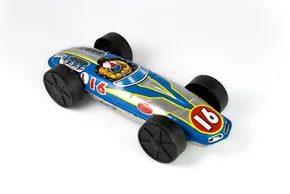
I remember building pinewood derby cars with my dad. Fond memories. But if you want to win, you need to stop thinking about aesthetics and start thinking about physics.
Here is the hard truth. Gravity is the engine. The rest is just slowing you down.
Imagine a vacuum. In a vacuum, a feather and a steel ball fall at the same speed. No air resistance. No drag. If you dropped two pinewood derby cars in a vacuum, they would hit the bottom at the exact same time. Every race would be a tie. It does not matter what the car looks like. It does not matter how heavy it is. In a vacuum, weight is irrelevant.
But we don’t race in vacuums. We race in air. And air fights back.
This is why you need a heavy car. The formula is simple: Force = Mass x Acceleration. Acceleration due to gravity is constant. So mass is your lever. More mass means more force pulling the car down the track. That force has to overcome aerodynamic drag. You want the pulling force to be as high as possible.
Could you make a lighter car faster? Only if you cut the air resistance by more than half. On a pinewood derby car, that is nearly impossible. The wheels and axles create most of the drag. You can’t remove them. So max weight is your best friend.
The Three Frictional Forces
As the car rolls, three things try to stop it.
- Air resistance
- Axle friction
- Tire stickiness
You can’t control the tires. They are plastic. They are standard. Ignore tire stickiness. Ignore tire diameter. Ignore rotational inertia. Those are fixed variables. You have no power there.
Focus on the other two.
Air Resistance vs. Axle Friction
Your son might have an idea about wings. Maybe a car that “flies”? Wheels off the ground? Zero axle friction?
Here is the catch. Wings generate lift. But wings also generate drag. So you are trading axle friction for aerodynamic drag. Which is worse?
Most evidence suggests axle friction is lower than the drag created by lift. But to be sure, you’d need sensitive equipment. Or you’d need to build five cars and test them.
I’m guessing you don’t have wind tunnels. So here is the pragmatic approach.
Create the lowest aerodynamic drag possible. Then drive axle friction toward zero.
Axles generate a lot of friction. You need to polish them. Put them in a drill. Polish with steel wool. Then use rouge. Then apply a dry lubricant. Silicon works. Graphite works. Do not use oil. Oil attracts dust. Dust creates friction.
Make sure the wheels are perfectly round. Balanced. The axle hole must be dead center. If the hole is off, the wheel wobbles. Wobbling creates drag. Drag loses races.
This is not rocket science. But it is not just carving a block of wood into a shape that looks fast. It is about minimizing resistance while maximizing gravitational force.
Polish the axles. Center the holes. Maximize the weight. Ignore the wings.
Good luck.