





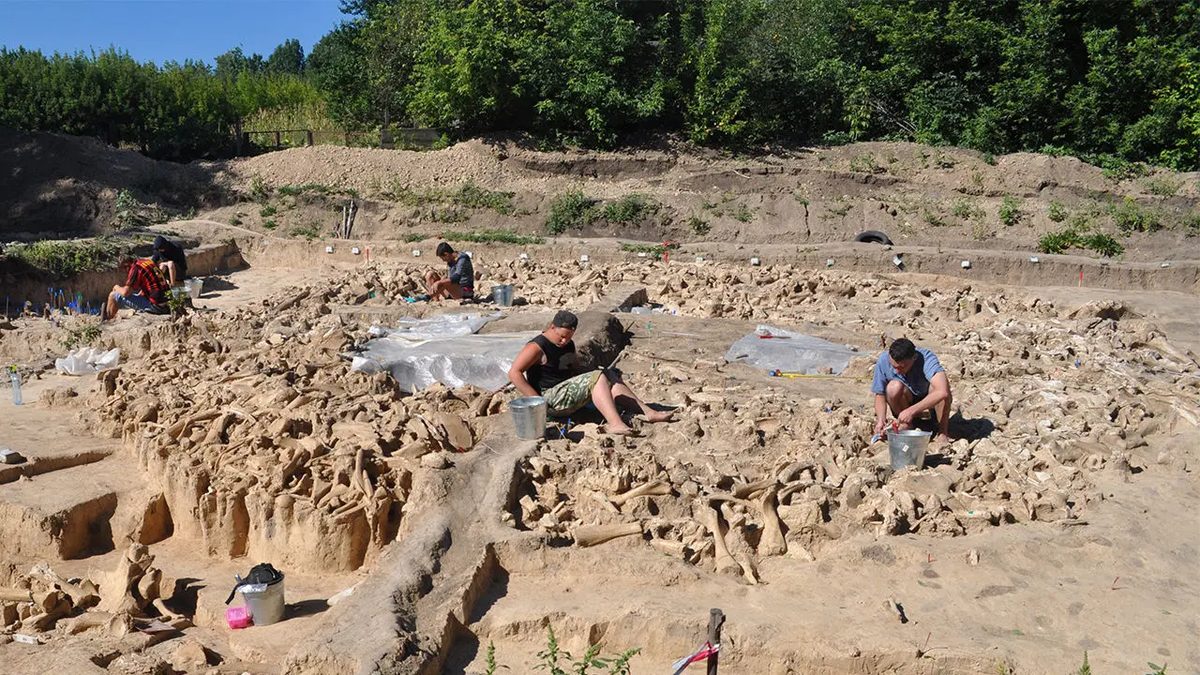
Deep in the snowy plains of Russia, about 500 kilometers from Moscow, archaeologists have known about a strange circular structure for years. It was built roughly 25,000 years ago. The walls were made of at least 60 mammoth bones.
Today, you only see a pile of them. They were first discovered in 2014 at the Kostenki 11 site. This is the oldest structure of its kind found in Russia. It belongs to a larger complex that includes two smaller, similar circular walls also made of mammoth bones.
For a long time, experts thought these were homes. The theory was simple. The area lacked trees. People needed shelter. So they used what was available. They piled up heavy bones to create walls.
Rethinking Ancient Mammoth Structures
New research suggests the old theory was wrong. A recent study published in Antiquity challenges the idea that humans lived inside these rings. The diameter of the main wall is 12.5 meters. That is huge.
It is too large to have had a roof. Think about the engineering required. You need strong beams to support a roof over such a wide space. No wooden beams were found. No other materials suggest a ceiling existed.
Furthermore, the bones tell a specific story. Only mammoth bones were used. If this were a dwelling or a hunting camp, you would expect to see bones from other animals. Fish. Birds. Reindeer. None of that was there. This makes the “shelter” theory highly unlikely.
Why Build a Mammoth Bone Ring Without Trees?
So why did people take the time to build this? Moving mammoth bones is not easy work. It requires coordination. It requires effort. There must have been a reason.
Archaeologists used to believe these structures compensated for a lack of trees during the Ice Age. The prevailing wisdom was that the landscape was barren. People had no wood for shelters or fuel.
Recent findings contradict that. Hundreds of pieces of pine charcoal were found near the site. This proves trees were present in the region during the last Ice Age. People had wood. They could have built normal houses if they needed to.
This creates a puzzle. Why build a massive bone circle when wood was nearby?
Ritual Sites or Ancient Pantries?
The authors of the new study offer different explanations. They suggest the site had a ritualistic purpose. It might have been a ceremonial space. A place for gathering. For rites. For community bonding.
Or, it could have been a pantry. A storage area. Mammoth meat preserves well in cold climates. The bones might have been used to mark storage pits. To protect food from scavengers. To organize the camp.
It could be both. A ritual space that also served practical needs.
The role of this enigmatic construction remains unclear, but the evidence points away from simple housing.
We may never know for sure. The people who built this are gone. Their language is lost. Their reasons are buried under ice and time.
But the structure itself speaks volumes. It shows sophistication. It shows a society capable of large-scale cooperation. It shows a culture that valued certain spaces enough to dedicate hundreds of

Keeping up with the science feed
The digital landscape moves too fast for static newsletters alone. That is why many science and tech enthusiasts now turn to real-time messaging platforms like WhatsApp and Google News to stay current. The goal is simple. Catch the breaking stories before they get buried under noise.
Why instant updates matter in tech
Science does not wait for the weekly print cycle. Breakthroughs in quantum computing or new space mission data often drop on a Tuesday afternoon. By integrating WhatsApp and Google News into your daily routine, you bypass the delay. You get the raw data first.
This method of consumption shifts the power from the publisher to the reader. You curate what you see. You filter the signal from the static.
“Real-time alerts ensure you catch significant developments in science and technology before they become yesterday’s news.”
How to set up these feeds
Getting started is straightforward. For WhatsApp, you typically subscribe to official channels or groups run by reputable scientific outlets. These are not random spam lists. They are curated feeds where editors vet the news before it hits your chat list.
Google News takes a different approach. It uses algorithms to aggregate stories from a vast array of sources. You can customize these alerts based on specific interests. Whether it is astrophysics, biotechnology, or artificial intelligence, the feed adapts to your queries.
The advantage of decentralized science news
Centralized newsrooms can be slow. They have editorial meetings. They have fact-checking protocols that take time. While necessary for deep dives, this latency leaves gaps in immediate coverage.
Decentralized feeds fill those gaps. They provide snapshots. They offer headlines. They point you toward the deeper analysis later.
This hybrid approach—quick alerts via WhatsApp and broad aggregation via Google News —creates a robust information ecosystem. It allows you to scan the horizon quickly. Then, you can dive deep into the stories that actually matter to your work or curiosity.
The science community thrives on shared knowledge. Keeping your channels open ensures you are part of that conversation. Not a passive observer. An active participant. The next big discovery might be waiting in your notifications right now.