


Long before CGI could generate a dragon’s breath or a galaxy far away, animatronics were already stealing the show. Think about it. The terror of the shark in “Jaws”. The quiet empathy of E.T. in his backyard. These weren’t just puppets. They were mechanical marvels that felt terrifyingly real.
So, what exactly is an animatronic device?
It’s a mechanized puppet. 🤖
The creator controls it. Sometimes via pre-programmed sequences. Sometimes by remote control. The range of motion varies wildly. Some devices do one thing. Others move with startling versatility.
Why Animatronics Defined a Generation of Cinema
“Animatronic creatures often seem as real to us as their flesh-and-blood counterparts.”
This wasn’t just about movement. It was about presence. When Steven Spielberg needed a shark that felt like a force of nature, he didn’t rely on digital wires. He built a mechanical beast. The results? Groundbreaking.
Animatronics became the backbone of 1980s and 90s blockbusters. They were precise. They were ingenious. They required dedication. The actors reacted to them. The audience felt them. That tactile reality is something digital effects still struggle to replicate.
The Mechanics Behind the Magic
How do you make a puppet blink? Or growl? Or reach out a hand?
The answer lies in hydraulics, servos, and intricate engineering. A simple lever can mimic a muscle. A small motor can drive a jaw. The best animatronics don’t just move. They breathe. They twitch. They hesitate.
These devices were limited by their programming. But that limitation created character. A robot that moves jerkily feels more authentic than one that glides. The glitches became part of the charm.
Where Are They Now?
Some studios still use them. Disney parks rely on them. Horror films love them for close-up scares. But the era of the giant screen animatronic has faded. CGI took over. It’s cheaper. It’s easier to fix in post-production.
Yet, there’s a nostalgia for the physical. Fans remember the smell of grease. The hum of motors. The way light hit a rubber skin.
We missed something. We traded texture for convenience. And now, we’re looking back. Not just at the movies. But at the hands that built them.
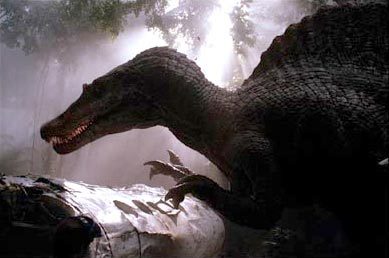
The Spinosaurus isn’t just CGI. It’s a massive, breathing, biting mechanical beast.
Created by Stan Winston Studio (SWS) for Jurassic Park III, this wasn’t a digital afterthought. It was a physical monster. Universal Studios wanted the apex predator to feel real. Heavy. Dangerous. The team at SWS didn’t just build a suit. They built an ecosystem of hydraulics, steel, and flesh-like silicone.
This article focuses on the creation of that animatronic. We are looking at the collaboration between SWS and Universal. We are breaking down the engineering behind a creature that dominates its scene. Not with pixels. With pistons.
The Design Philosophy: Bigger Than T-Rex
Why Spinosaurus? The script called for a new top of the food chain. The T-Rex was out. This creature was larger. It had a sail. It had a crocodile-like snout.
The design had to serve the story. It needed to look like it could eat a helicopter. Or at least try.
Stan Winston’s team didn’t just guess the proportions. They studied real anatomy. Pterosaurs. Crocodiles. The goal was a hybrid look that felt plausible. Even if the animal itself is debated by paleontologists today, the animatronic needed to look right on camera.
John Rosengrant and Stiles White led the sculpting. They worked directly with the production team at Universal. Brett Levisohn at Universal helped bridge the gap between art and engineering. The result was a design that prioritized menace over scientific accuracy.
It had to scare people.
Building the Beast: Hydraulics and Steel
You don’t build a 20-foot dinosaur with glue and hope. You build it with a skeleton.
The internal structure of the Spinosaurus animatronic was a complex rig. Think of a massive exoskeleton. Hydraulic lines ran through it like veins. Compressed air and fluid moved the jaw. The neck. The tail.
Every movement was controlled.
The animatronic wasn’t a static prop. It was a machine with intent.
The head alone weighed hundreds of pounds. Moving it required precision engineering. One wrong signal and the jaw snaps shut on an actor. Or worse, breaks the machine.
The skin was silicone. Thick. Textured. Painted by hand. Each scale was a small work of art. The coloration wasn’t flat. It had depth. Shadows. Highlights that changed with the studio lights.
This wasn’t a costume. It was a puppet. A giant, terrifying puppet.
On-Set Control: The Human Element
How do you move something this big on a tight movie schedule? You don’t. You don’t leave it to chance.
Operators stood inside or near the rig. They watched monitors. They pulled levers. Every bite. Every head turn. It was manual labor. High-stakes, high-precision manual labor.
Stan Winston himself was involved in the oversight. He knew the language of film. He knew how light hit silicone. He knew how to make the eyes look alive.
The collaboration was tight. SWS. Universal. The directors. They communicated constantly. Adjustments were made daily. If the jaw moved too
The Evolution of Digital Dinosaurs
The “Jurassic Park” franchise built its reputation on one thing: making prehistoric beasts look terrifyingly real. It didn’t matter if you were looking at clunky animatronics or early CGI. When the original film dropped in 1993, it forced Hollywood to acknowledge that we had never actually seen a dinosaur alive. Yet, the screen showed us enough to believe they were breathing, hunting, and dying.
Then came “Jurassic Park II: The Lost World.” It didn’t just repeat the formula. It refined the vision. The creatures felt more integrated into their environment. Less like monsters on a set. More like animals in the wild.
But “Jurassic Park III” raised the bar again. Steven Spielberg’s third installment pushed the technology further. The T-Rex sequence alone proved that digital effects could carry the weight of a blockbuster without feeling artificial. The line between practical and digital blurred. The audience stopped asking if it was real. They started asking what happens next.
The realism wasn’t a gimmick. It was the entire point.
Fans still debate which era had the better beasts. Some miss the tactile weight of the practical effects. Others argue the digital versions offered more dynamic movement. But the progression is undeniable. Each film outdid the last. Not just in budget. But in belief.
The Jurassic Park III dinosaurs weren’t just recycled props. They were fresh starts. The Velociraptors got a paleontological update. The T. rex was redone. But it wasn’t the star anymore. That crown passed to Spinosaurus. A monster that dwarfs even the mighty T. rex. This is the largest animatronic creature SWS has ever built. It’s bigger than the T. rex Winston’s team built for the original “Jurassic Park”!
Check out these amazing Spinosaurus statistics:
-
It is 43.5 feet (13.3 m) long — almost as long as a bus — and weighs 24,000 pounds (10,886.2 kg/12 tons).
-
It is powered entirely by hydraulics, even down to the blinking of the eyes. This is because the creature was made to work above and below water.
-
There are 42 hydraulic cylinders and approximately 2,200 feet (671 m) of hydraulic hoses.
-
The creature moves on a track that is 140 feet (43 m) long and made from a pair of 12-inch (30.48 cm) steel I-beams.
-
All pivots use roller-bearing construction.
-
All large steel pieces were cut using waterjets.
-
The creature is completely remote-controlled.
How did SWS build this amazing device? In the next section, we’ll look at the standard process used to develop animatronic devices. We will then look in detail at the various steps involved.
Dinosaur Evolution
The Spinosaurus is based on a real dinosaur that paleontologists have recently discovered. This basis in reality can be both good and bad for the design crew. The good side is that they have a solid foundation to start with. The bad side is that it provides a very specific set of criteria that must be matched.
The Spinosaurus holds the title for the largest carnivorous dinosaur ever discovered. That fact alone makes building it for the big screen an engineering nightmare. You cannot simply wire up a giant lizard and hope for the best. There is a specific, brutal process for turning a concept into a moving, breathing threat.
It starts with paper. Then it moves to clay.
The full pipeline is long. You sketch. You build a maquette, which is just a fancy word for a miniature scale model. From there, you scale up to a full-size sculpture. Then you mold that sculpture. Then you cast the body. You install the hydraulic bones and servos. You assemble the beast. Finally, you test it until it breaks, then fix it.
A complex animatronic like this usually demands two years of labor. Deadlines do not care about art. Budgets do not care about perfection. In the real world, you have to ship it.
According to John Rosengrant, who served as the special effects supervisor for Jurassic Park III, the Spinosaurus defied the standard timeline. It went from initial concept to final product in less than a year. Rosengrant led a team of roughly 75 designers, engineers, and artists at Stan Winston Studio (SWS). About 30 of those specialists focused exclusively on the Spinosaurus.
That is a massive amount of manpower for a single dinosaur. And they did it fast.
In The Beginning
The creation of any animatronic begins with two critical phases: the sketch and the miniature.
Put It on Paper
Before a single screw is turned, an artist must visualize the monster. For the Spinosaurus, this meant collaborating closely with Jack Horner, an expert paleontologist. Horner was working alongside the Jurassic Park III film crew. His input shaped the anatomy. The sketches were reviewed. Changes were suggested. The design evolved.
Eventually, the artist produced a detailed illustration that served as the blueprint. For SWS, the journey from rough preliminary sketches to a finalized design took only about three weeks. Three weeks to nail down the look of the world’s biggest meat-eater.
It sounds fast. It was.
From Sketch to Clay: The First Physical Proof
“The paper sketches are vital. Everything else relies on the accuracy of these designs.”
It starts with a pencil. An artist at Stan Winston Studio is likely staring at a blank page, trying to capture the chaotic, prehistoric energy of a Spinosaurus. These aren’t just doodles. They are the blueprint. If the drawing is wrong, the entire creature fails before a single piece of clay is touched. The sketches dictate the silhouette, the texture, and the menace. Without that accurate line work, you’re just sculpting a lizard with a bone sail.
Once the paper design is signed off, the process moves from 2D to 3D. You don’t jump straight to the life-sized animatronic. That’s a recipe for disaster. Instead, you build a maquette.
The Miniature Test
This is where the rubber meets the road. A maquette is a miniature scale model, and for the Spinosaurus, the Stan Winston Studio (SWS) team started small. One-sixteenth scale. That’s tiny.
Why so small? It’s a validation step. The clay model acts as a truth serum for the paper design. It reveals proportions that look fine on paper but look goofy in three dimensions. Maybe the tail is too long. Maybe the arm looks like a chicken leg. If there are problems, you don’t tear up the final plans. You go back to the drawing board.
You correct the errors on the mini-clay version. Then you update the paper design. And you build a new maquette.
It’s a loop. Draw. Build. Break. Fix. Repeat.
From Maquette to Mega-Saur
The journey from a rough sketch to a terrifyingly real dinosaur doesn’t end at the drawing board. Next up is a one-fifth-scale maquette. To you, that sounds tiny. To the Spinosaurus, it’s massive. This specific model stretched about 8 feet (2.4 m) long. Why go big on a small scale? It gives the designers room to add serious surface detail without losing the overall shape. This maquette isn’t just a toy. It’s the blueprint for the full-size sculpture that will eventually chase people around the screen.
Big as Life
Once the sketches are locked and the models are scanned, the real work begins. The goal is to build something that looks and moves like a living, breathing prehistoric predator.
Building the Beast
In the original Jurassic Park days, Stan Winston Studio had to carve these monsters by hand. It was slow. It was painful. It was expensive. Advances in computer-aided manufacturing (CAM) changed the game. Now, they don’t just carve. They calculate.
The maquette gets shipped out to Cyber F/X. There, it meets a 3-D digitizer. Don’t confuse this with the scanner you use at a library. This machine is precision engineering at its finest. For the Spinosaurus, they used laser scanning.
How does it work? The machine bounces beams of laser light off the maquette’s surface. As the scanner moves, it fires over 15,000 beams every single second. High-resolution cameras on either side catch the reflected light. They don’t just take a picture of the whole thing. They capture a slice. A cross-section.
A custom computer system collects these thousands of slices and stitches them together. The result? A perfect, seamless computer model of the maquette.
This digital twin is exact. No guesswork. No error margins. Just pure, measurable geometry. And from this data, the full-size sculpture comes to life.
The transition from digital design to physical reality wasn’t just about scaling up. It involved a proprietary milling technique developed by Cyber F/X. They used CNC-Sculpting® to turn polyurethane foam into the basic shape of the dinosaur. This rigid foam gets cut into manageable chunks. The data from the computer model drives tiny spinning blades. These blades whittle away sections of solid foam blocks.
Then the assembly begins. The Stan Winston Studio team treats the pieces like a giant 3D puzzle. They fit the milled sections together. The result is a rough, full-sized model. But this is just the skeleton of the process.
Hand-Carved Realism
A computer model can’t capture every scale and wrinkle. Sculptors at the studio took over from there. They hand-carved the foam to add incredible detail. This manual labor is what makes the creature look real. The machine provided the mass. The artists provided the life.
“A lot of work still needs to be done and it is handled by a team of sculptors at Stan Winston Studio.”
The Molding Phase
Once the sculpture was complete, they needed molds. The team created a set from durable epoxy. This material has strong bonding characteristics. It was built to withstand the casting process. The epoxy molds preserved every detail the sculptors had carved by hand.
The process moved from digital chunks to physical foam. Then to hand-sculpted detail. Now, it’s about preservation through replication. The next steps involve casting. But the foundation was laid in that foam. And in the epoxy.
The frame work gets test-fitted inside the molds before the foam rubber skin is ever cast. It is a precise dance of layers. Stan Winston Studio lines the inside of the mold with exact clay thickness to mimic real skin. They fiberglass that clay surface. Then they clean out the clay. What remains is the foam-running core.
Bolted into the mold, this core creates a negative space. Fill that space with foam rubber and you get the skin. Why bother with such a complex setup? Two reasons. It makes the movement look natural. It controls the weight and thickness of the skin. Without this step, the creature looks like a stiff costume. With it, the skin moves independently of the mechanics.
How to build an animatronic creature
Creating the components takes the most time. Most of what Stan Winston Studio builds does not exist in any hardware store. You will not find a left forearm for a Spinosaurus at Home Depot. Or a tail for a T-Rex. They build almost everything from scratch.
They do use existing products when possible. They repurpose common devices to fill uncommon needs. This creative reuse is the best way to learn how to build animatronic parts yourself. Start with what you have. Modify it. See how it moves.
The process creates a negative space between the foam-running core and the mold’s detailed surface. This determines the final skin thickness.
It is about resourcefulness. Not just finding the right part. But making the part out of something else. That is the real skill.
The Mechanics of a Monster
The magic behind the scenes at the Stan Winston Studio didn’t just happen by accident. It required a massive, synchronized effort split into four distinct operational categories. These teams didn’t work in silos. They developed their respective pieces simultaneously, ensuring the final product was a cohesive beast rather than a patchwork of conflicting parts.
One of those pillars is pure mechanical engineering.
SWS engineers were tasked with designing and building the physical skeleton of the creature. This meant dealing with everything from basic gears to sophisticated hydraulic systems. The choice of propulsion wasn’t arbitrary. For the animatronic Spinosaurus, nearly all mechanical systems relied on hydraulics. It was a heavy-duty approach, prioritizing raw power and fluid movement over lighter alternatives.
Then there is the nervous system. The electronic group had to develop the control systems needed to operate the animatronic device.
These engineers typically started from scratch. They didn’t just plug into existing hardware. They created their own custom circuit boards, essentially building giant remote-controlled toys with a high-stakes payoff. The goal was precision. Almost all movement of the Spinosaurus was manipulated by specialized remote-control systems known as telemetry devices.
“These engineers are essentially building giant remote-controlled toys.”
This distinction matters. It wasn’t pre-recorded animation. It was live manipulation. The telemetry devices allowed operators to control specific joints and motions in real-time. This set the stage for the next phase of development, where the specific telemetry hardware was detailed further. But the foundation was laid here: a hydraulic muscle structure guided by custom electronics.
All the hydraulic systems were in. They were checked. Then came the hard part: making it look real.
The Skeleton and Skin
You can’t just hang wires in the air. Electronic and mechanical bits need a home. The suit needed a frame to hold its shape. Stan Winston Studio didn’t sketch a cartoon. They built a frame that mirrored the actual skeleton of the beast.
Most of that skeletal structure is graphite. It’s a synthetic material. It’s light. It’s strong. It’s the natural choice for animatronics.
The surface was a different story. The “skin” used foam rubber. It’s a spongy, lightweight rubber made by mixing air with liquid latex. Then you cure it. Hardening.
Silicone is stronger. Urethane lasts longer. But foam rubber is easier to work with. That’s the trade-off.
The liquid solution is poured into molds. Parts of the frame are embedded directly into the foam rubber at specific points for strength. A piece of fabric is cut to size and shoved into the wet mix. It adds tensile strength. Once it cures, the skin is pulled from the mold.
Putting it Together
Time to assemble.
The frame goes up first. Then the mechanical systems slide in. It’s not a blind insert. Every component is checked as it’s added. Does it move properly? Does it clash with the gears behind it?
The electronics connect to the mechanics. The controls had been tested before final assembly. But they are checked again. Redundancy. Precision.
The suit breathes. It moves. But is it alive yet?
The Mechanics of Illusion in Spinosaurus’ Skin
It’s not just about slapping rubber over a metal skeleton. The real work begins when you start treating the skin like a second chassis. Parts of the hide actually have embedded structural pieces, so they snap onto the frame during the initial assembly. The rest? Those get bolted on only after the guts—the mechanics and electronics—are fully installed.
Assembling the skin is a headache. It’s laborious. You’re adding piece after piece, constantly checking for errors.
Think about what can go wrong:
- Unwanted folds ruining the silhouette
- Buckling where there shouldn’t be any
- Stretching that distorts the anatomy
- Tension that’s simply too tight
If any of that happens, you have to adapt. You have to reattach. It’s a constant loop of fix and check. But it’s not all about fixing mistakes. Sometimes you want the skin to fold. You want it to hang loose in specific spots. You need it to travel in a certain way to sell the illusion of weight.
That’s where the trickery comes in.
Stan Winston Studio didn’t just rely on the rig. They used bungee cords. Tucked between the skin and the frame, these cords act as artificial tendons. When the animatronic moves, they bunch and stretch. It mimics the way real biological tissue reacts to motion. It’s subtle. It’s realistic. It’s the difference between a monster and a living thing.
One of the tricks that SWS uses to make the Spinosaurus and other dinosaurs seem more realistic is to attach bungee cords between areas of skin and the frame. During movement, these bungee cords simulate tendons under the skin, bunching and stretching.
The result isn’t just motion. It’s biology.
The Skin Problem and the Search for a Performance
Forget traditional paint. If you think Stan Winston Studio grabs a brush and slaps color onto their creations, you’re wrong. Photographer Chuck Zlotnick captured the studio’s process, but the reality is far more chemical. The team uses a specialized rubber-cement-like mixture. They tint it until the hue is exact. But why?
“Rosengrant says that they use this mixture in place of traditional paint because it bonds more strongly with the foam rubber and stretches with it as the animatronic moves.”
Regular paint cracks. It flakes. It looks dead. This custom blend moves with the foam. It holds up under stress. The skin gets prepped this way before it even touches the underlying frame. It’s a small detail, but it makes the difference between a monster and a character.
Then comes the stress test. Once the device is assembled, the team breaks it. They push it. They look for failures. Any problem that pops up gets fixed before the figure ever sees the camera.
Who Makes It Look Alive?
The operators aren’t engineers in white coats. They’re puppeteers. And yes, that’s the right word. An animatronic is just a sophisticated puppet. The difference is the budget and the wires.
These puppeteers are actors, first and foremost. They don’t just press buttons. They spend days with the figure. They learn its limits. They learn its language. Rosengrant calls this phase “finding the performance.”
It’s not about making it move. It’s about making it feel.
The puppeteer decides what makes the figure look angry. Not just a frown. The micro-tension in the jaw. The way the shoulders hunch. Or hungry. Or surprised. Every twitch is a choice. Every pause is a beat. The script might say “scared,” but the puppeteer has to figure out how that fear looks in three dimensions.
The puppeteers are determining what movements make the animatronic figure look angry, surprised, hungry or any other emotions or moods that are called for in the script.
It’s a collaboration between silicone and soul. The engineering provides the skeleton. The puppet provides the skin. But the puppeteer? They provide the ghost.
The Telemetry Behind the Beast
Eight puppeteers work in tandem to drive the Spinosaurus animatronic. It is a massive undertaking. Each operator handles a specific mechanical function. One team controls the basic head and body. They manage the jaw, the neck, and the side-to-side sway. Another pair handles the tongue slide levers. These move the tongue up, down, in, and out. There is an eye joystick control system. It handles blinking, eye movement, and the ridge above the eyes.
The front arms receive full range of motion commands. The hands open and close on command. A cart and body system moves the creature along a track. Inside the chest cavity, a breathing potentiometer inflates a bladder to simulate respiration. The tail moves with full range. A body raise slider lifts the entire frame up or down.
“Rosengrant is the coordinator… making sure that all of the other puppeteers are working in concert to create a realistic and believable motion.”
How the Arm Telemetry Works
The telemetry device for controlling the arms is unlike anything you see in standard remote controls. It is a bizarre contraption. The puppeteer straps the device directly onto his own arms. He acts out the movement. The device translates his physical motion into a signal. That signal hits the circuit board. The board drives the mechanical components.
Rosengrant coordinates the entire crew. They use handheld units. Some look like video-game joysticks. Others are custom-built. The goal is realism. The motion must be believable. The audience should not see strings or wires. They should just see a living, breathing dinosaur.
Why RF Interference Is Dangerous
The monster mash begins with safety protocols. The Spinosaurus animatronic control relies on radio-frequency (RF) devices. This creates a hazard. Any nearby RF device can cause interference. Cell phones must be turned off. Other electronics must be silenced. Improper signals can disrupt the control signals.
Imagine a 12-ton monster losing its mind. That is the risk. Clean power is equally important. The Spinosaurus has a dedicated uninterruptible power supply (UPS). A power surge or brownout would cause it to go out of control. The UPS prevents this. It keeps the beast stable.
The Power of a “Hot Rod” Animatronic
Rosengrant calls the Spinosaurus a “hot rod” animatronic device. It has more power than usual. The hydraulics use larger cylinders. They provide approximately 1,000 horsepower. The machine is so powerful it can tear a car apart.
When the tail whips from side to side, it reaches 2 Gs at the tip. One G is the force of Earth’s gravity. Two Gs is double that. The force is immense. The dinosaur moves with heavy, weighted purpose. It does not just look real. It feels heavy. It feels dangerous. The telemetry device for controlling the arms ensures that every punch, every swipe, and every bite is precise. But the power behind it? That is pure mechanical force. There is no stopping it once it starts moving.
The terror on the actors’ faces wasn’t acting. It was genuine. The animatronic Spinosaurus was terrifyingly real. It loomed large. It moved with heavy, hydraulic force.
Stan Winston Studio built this beast to survive. Water was everywhere in Jurassic Park III. Mist. Rain. Lakes. The machine had to handle it. Winston’s team sealed every joint. Every wire. Every sensor. They made the suit waterproof. Completely. You could submerge it. Turn it on. It would still work. That level of engineering is rare for such a complex prop.
The mechanics of a 5.5-meter monster
The creature sat on a platform. It rolled on tracks. Like a train. An 18-foot hydraulic cylinder pushed from behind. It shoved the Spinosaurus forward. Fast. Very fast.
Moving it to a new spot? That took a crane. A massive lift. It wasn’t a lightweight prop. It was heavy machinery disguised as a dinosaur.
Animatronic vs. CGI: The telltale sign
Blending the two was extraordinary. Almost everyone thinks what they see on screen is real. Or digital. Hard to tell the difference. Stan Winston gave us a cheat code. A simple rule.
Look at the whole creature.
If you see the entire Spinosaurus. Legs included. Moving freely across the screen. It is digital. CGI.
But most shots? They are not that wide. Close-ups. The face. The teeth. Those are likely the animatronic. Most of Winston’s figures did not have legs. Not the Spinosaurus. The ones that did have legs could not move with total freedom. They were anchored. Controlled.
Why go to such lengths? For the close-ups. The intimate terror. The CGI handles the wide shots. The animatronic handles the emotion. The actors react to weight. To presence. To a machine that breathes air. That shakes the ground. You cannot fake that reaction.
We rarely see the wires. The tracks. The crane. But they were there. Holding up the illusion. Keeping us scared.
The digital Spinosaurus that Industrial Light & Magic rendered on screen is nearly impossible to tell apart from the physical animatronic built by Stan Winston’s team.
After seeing the massive mechanical figure up close and actually touching it, the sheer intricacy of the craftsmanship becomes undeniable. It’s a reminder of how reality can be shaped by hands that understand both biology and engineering.
The Tech Behind the Roar
The dinosaurs in Jurassic Park III stand as some of the best examples of animatronic technology at its peak. The blend of practical effects and CGI creates a seamless experience for the audience. You get the weight and presence of a real creature, not just a floating polygon.
If you want to dig deeper into how this magic happens, there are plenty of resources available.
Where to Go Next
For those interested in the mechanics of movie magic, these links provide a solid foundation:
- How Blue Screen Special Effects Work – Understanding the backdrop of illusion.
- How Industrial Light & Magic Works – Inside the studio that defined modern VFX.
- How Centropolis Creates Special Effects – Another look at the industry heavyweights.
- How Hydraulics Work – The power source for those heavy mechanical limbs.
- How Gears Work – The simple machines driving complex movements.
- How Radio Controlled Toys Work – The control systems behind the scenes.
- How Iron and Steel Work – The materials that give the robots their skeleton.
- How Bearings Work – Because smooth movement is non-negotiable.
- How Waterjets Work – Precision cutting for custom parts.
- How the “Frozen” Effect in The Matrix Was Created – A different kind of visual trickery.
Beyond the Screen
The Stan Winston Studio remains a reference point for any fan of practical effects. Their work on Jurassic Park III set a standard that CGI still struggles to match in terms of tactile realism.
For the DIY crowd, there are guides on building your own animatronic skeletons and android heads. It’s a niche hobby, but one that requires serious engineering knowledge. Cyber F/X also offers insights into the technical side of creature effects.
The line between the real and the rendered continues to blur. But sometimes, touching the machine reminds you that there’s still meat and metal beneath the pixels.