




Imagine factories. But not the loud, smoky ones. Think quiet tanks. Living tanks.
Plastic is broken. It cracks into micro-fragments that linger in our guts, our oceans, and our air. BPA, phthalates, carcinogens—the list of what plastic leaves behind is long and unpleasant. We need something else. Something that grows.
Researchers at Rice University and the University Houston found it. Or rather, they taught it.
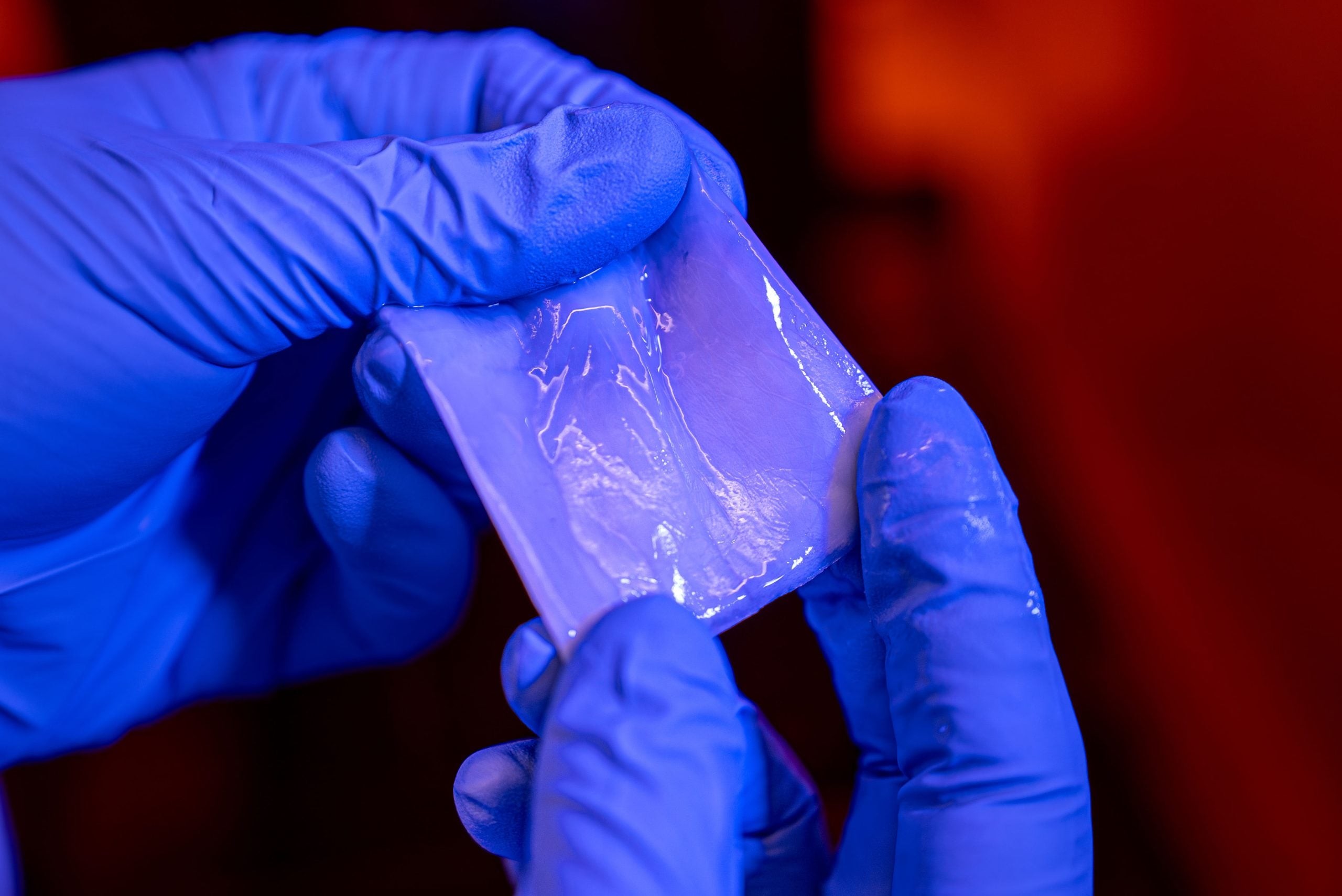
They engineered a new manufacturing technique for bacterial cellulose. This stuff isn’t made in a lab flask by a human; it’s woven by microbes. And when done right, it rivals steel and glass. The findings dropped in Nature Communications. The premise? Scalable. Strong. A replacement for the single-use plastic world we built.
Dancing Cells Make Stronger Sheets
Normally, bacterial cellulose fibers grow wild. Randomly. Like tumbleweed caught in a breeze. Random growth means weak structures. It doesn’t hold up under stress.
Muhammad Maksud Rahman led the team. He’s an assistant professor at UH and adjunt at Rice. He knows materials. He knew that chaos was the problem. So his team, including first author M.A.S.R. Saadi—a doctoral student—built a rotational bioreactor.
This isn’t a static vessel. It spins. It forces the bacteria to move.
“We instruct them to move in a specific,” Saadi explained.
The bacteria comply. Their motion aligns the cellulose nanofibrils. Think of it like ironing out a wrinkle at the molecular level. The result? Sheets with tensile strengths up to 436 megapascals. That’s strong. Really strong. For a biopolymer.
They didn’t stop there. They added boron nitride nanos sheets. Now we’re talking hybrid materials. The strength jumped to roughly 553 megapascal. It’s also flexible. Foldable. Transparent. And it handles heat. Like, three times faster than the control samples. Dissipation is key. If your phone doesn’t get hot, or your electronics don’t melt, you have a winner.
Not Just Strong, but Smart
Is this just another lab curiosity? No. Saadi called the process “training a disciplined bacterial cohort.” I like that image. Bacteria in marching drills.
The alignment happens during growth. It’s a single step. No messy post-processing. That’s the magic. Scalability usually eats efficiency for breakfast, not here. You can tweak the additives. Customize the output.
Shyam Bhakta from Rice helped with the biology. Pulickel Ajayan and Matteo Pasquali chipped in on the materials science. It’s interdisciplinary. messy human work, coordinated perfectly.
What does this actually replace?
- Structural components
- Thermal management systems
- Packaging
- Green electronics
- Textiles
- Energy storage
Plastic is everywhere. This material can go there too. Except it doesn’t leave toxic debris behind. Rahman envisions these sheets becoming ubiquitous. He wants to see the end of plastic dominance. It’s ambitious. Maybe too ambitious for tomorrow, but the science is sound.
We are funding this work through the NSF, the U.S. Endowment for Forests and Communities, and the Welch Foundation. The views are theirs, not necessarily the funders’.
So here we are. A strong, transparent sheet made by microbes that listen to a spinning tank. It absorbs heat better than metal. It’s stronger than some ceramics. And it rots without poisoning the soil.
The factories might stay quiet for now. But the tanks are already spinning. Will we let them fill the world?