




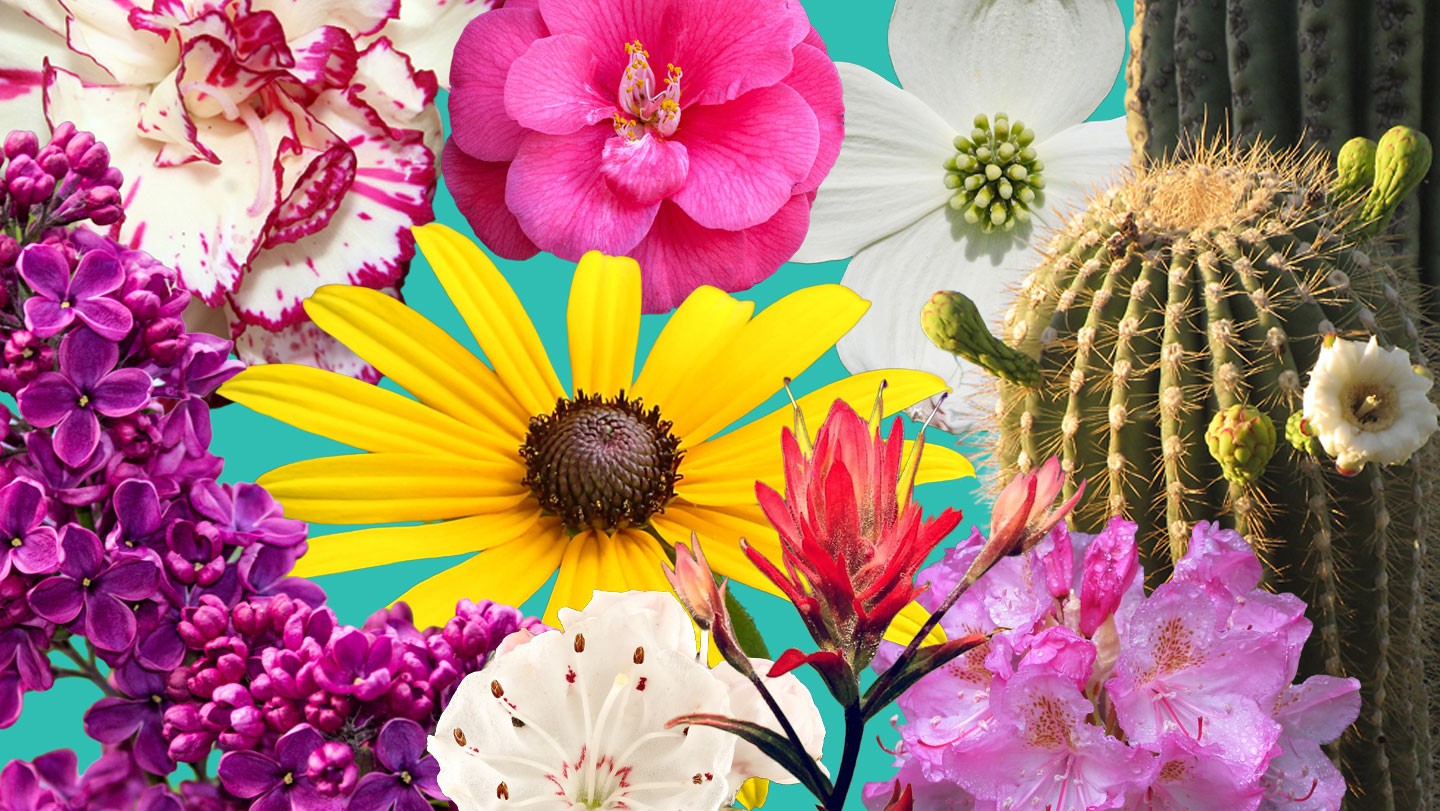
The United States is approaching a major historical milestone: its 250th anniversary. To mark the occasion, the U.S. Botanic Garden (USBG) in Washington, D.C., has launched a special exhibition dedicated to the nation’s state flowers. Running through October 12, the exhibit invites visitors to explore the botanical diversity of all 50 states, the District of Columbia, and U.S. territories.
This is not merely a decorative display. It serves as an educational journey into the history, medicine, and ecology of American flora, while simultaneously raising urgent questions about how climate change is reshaping the natural landscape—and potentially the symbols we use to represent it.
A Scavenger Hunt Through History and Science
Visitors are encouraged to navigate the glass-domed conservatory and outdoor gardens in a self-guided scavenger hunt, locating blooms that represent each jurisdiction. The exhibit highlights that state flowers are often more than just aesthetic choices; they are deeply tied to regional identity and utility.
Take Oregon’s state flower, the Oregon grape (Berberis aquifolium ). Despite its name, it is not a grape but a shrub with significant medicinal value. Lisa Philander, the garden’s deputy executive director and a medicinal plant expert, notes that compounds from the plant have historically been used to treat conditions ranging from bleeding and arthritis to tuberculosis.
In contrast, Minnesota’s emblem, the pink and white lady’s slipper orchid (Cypripedium reginae ), represents ecological fragility. It is the only orchid among all state flowers and has strict survival requirements: it grows only in regions with harsh winters. Consequently, it is illegal to pick it in the wild, underscoring the tension between appreciation and conservation.
The “Odd” Choices That Define Identity
Not all state emblems fit the traditional definition of a flower, revealing how local culture influences botanical selection. Susan Pell, the USBG’s executive director, points to Maine as a prime example. The state’s official floral emblem is the white pine cone and tassel.
“It doesn’t actually have flowers at all but does definitely represent the state of Maine very well,” Pell explains. The Eastern white pine (Pinus strobus ) is the tallest conifer in the Northeastern U.S. and has been central to Maine’s economy since the 17th century. Adopted as the state symbol in 1895, it remains a cultural icon, appearing on license plates today. “I think Maine likes being a little bit weird,” Pell says, highlighting how state symbols often prioritize historical and economic significance over strict botanical classification.
Preserving the Past to Understand the Future
For those who miss their favorite bloom during its peak season, the exhibit offers a permanent solution: a collection of anatomically accurate paper flowers created by Washington, D.C.–based artist Emily Paluska. Displayed in a glass case in the conservatory lobby, these replicas sit alongside books of preserved dried specimens.
These dried specimens are not just archives; they are scientific tools. “Researchers collected the flora to take a snapshot in time of what plants were occurring in a certain area,” Pell says. This data allows scientists to track the impacts of climate change, urban development, and invasive species on native plant ranges.
The implications are stark. As global temperatures rise, many plant species are migrating northward or to higher elevations. In some cases, if plants cannot migrate further, they face local extinction. This biological shift raises a provocative question: If a state’s official flower disappears from its native range, should the state choose a new symbol?
Changing Symbols in a Changing Climate
States are already adapting their symbols to reflect ecological reality. Just prior to the exhibit’s opening, Georgia updated its official flower. The state replaced the Cherokee rose (Rosa laevigata ), an introduced species from Asia, with the sweetbay magnolia (Magnolia virginiana ), a species native to Georgia.
This change reflects a broader trend toward prioritizing native biodiversity over introduced ornamentals. It also serves as a reminder that state symbols are not static; they evolve alongside the land and its inhabitants.
“I will say that states are continuously changing their state flowers,” Pell says.
Conclusion
The U.S. Botanic Garden’s exhibit offers more than a festive celebration of America’s 250th birthday; it provides a lens through which to view the nation’s ecological heritage and future challenges. By showcasing the diversity and vulnerability of state flowers, the exhibit underscores that our natural symbols are living entities, subject to the pressures of climate change and human activity.