



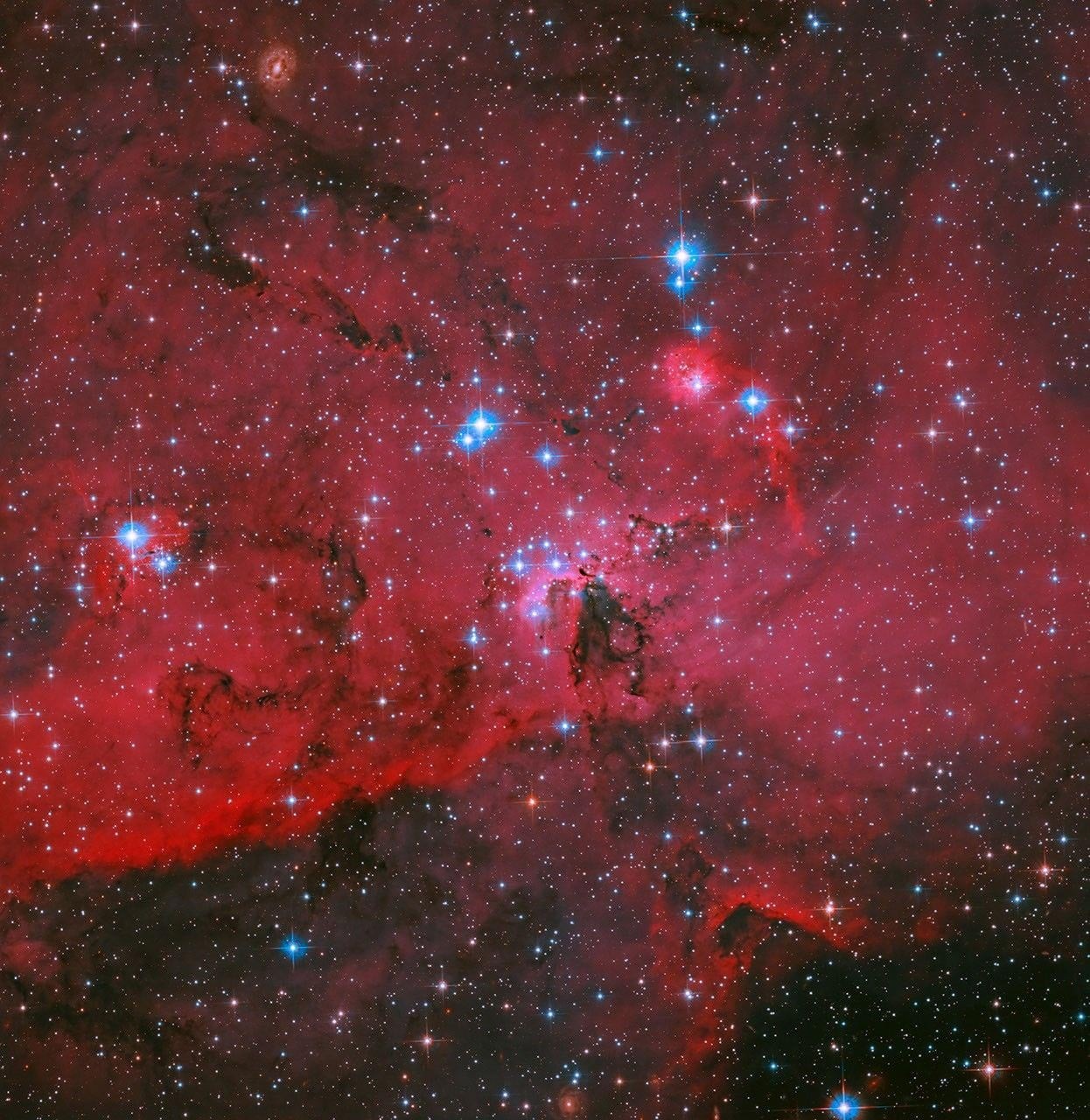
Hubble just dropped a view that looks less like science and more like an artist’s mood board. LH 95. That’s the name of this stellar nursery tucked inside the Large Magellanic Cloud—a dwarf galaxy orbiting our own Milky Way. The colors? A punchy mix of crimson, blue, and white. It reminds people of fireworks fading into smoke.
It isn’t pretty just for the sake of being pretty.
Giants Bullying Their Neighborhood
The big blue stars here are the bullies of the local cosmic schoolyard. Some have at least three times our Sun’s mass. They radiate intense UV light. Their stellar winds are violent enough to carve out the very gas that birthed them.
The result? Sculpted nebulae.
You might think everything gets erased, but dense dust ribbons remain. They show up as dark filaments cutting through the glow. Thick stuff doesn’t erode as fast.
The image itself is a map, not a photograph in the traditional sense. Blue marks shorter visible wavelengths. Red captures longer visible waves plus some near-infrared. That specific crimson glow? It’s hydrogen alpha. A signature signal.
Hydrogen alpha is the neon sign saying “Star Factory Open.”
The Growing Pains of 2,500 Suns
Hide-and-seek is the main game here. The red glow hides extremely young stars. About 2,500 of them.
They are still hungry. Feasting on disks of gas and dust swirling around them.
Technically, these are pre-main-sequence stars. They have gathered almost all the mass they will ever need, but the nuclear fusion switch hasn’t been flipped yet. Gravity has pulled the clouds in. The clouds are still contracting. Wait until the cores get hot enough. Then the real star show begins.
For a long time, we assumed these young stars stopped gaining weight relatively quickly. Wrong.
Observations show they keep eating. And eating. And eating for millions of years. The rate slows down as they age, but the duration of the gluttony exceeds previous estimates. This changes how we understand disk evolution.
Old Meets Young
It isn’t one big explosion of creation. LH 95 churned out stars over time.
Different generations share the same crib.
Check the top-left of the image. Just slightly left of center. There sits a monster. Sixty to seventy times the mass of our Sun. Here’s the kicker: it’s baby-faced. About a million years young. The surrounding neighborhood is four million years old.
This giant will burn bright and burn fast. It will eventually blow up in a supernova. Spectacular. Short-lived.
Why care?
The Milky Way is dusty. Messy. Hard to see through. The Large Magellanic Cloud offers a cleaner view. A natural laboratory nearby. We can watch birth pangs without the visual static.
Hubble has been doing this for thirty years. It doesn’t rest now either. It passes the torch to James Webb. Then later this summer, Nancy Grace Roman joins the club.
We’re peering back in time, one hydrogen atom at a time.