





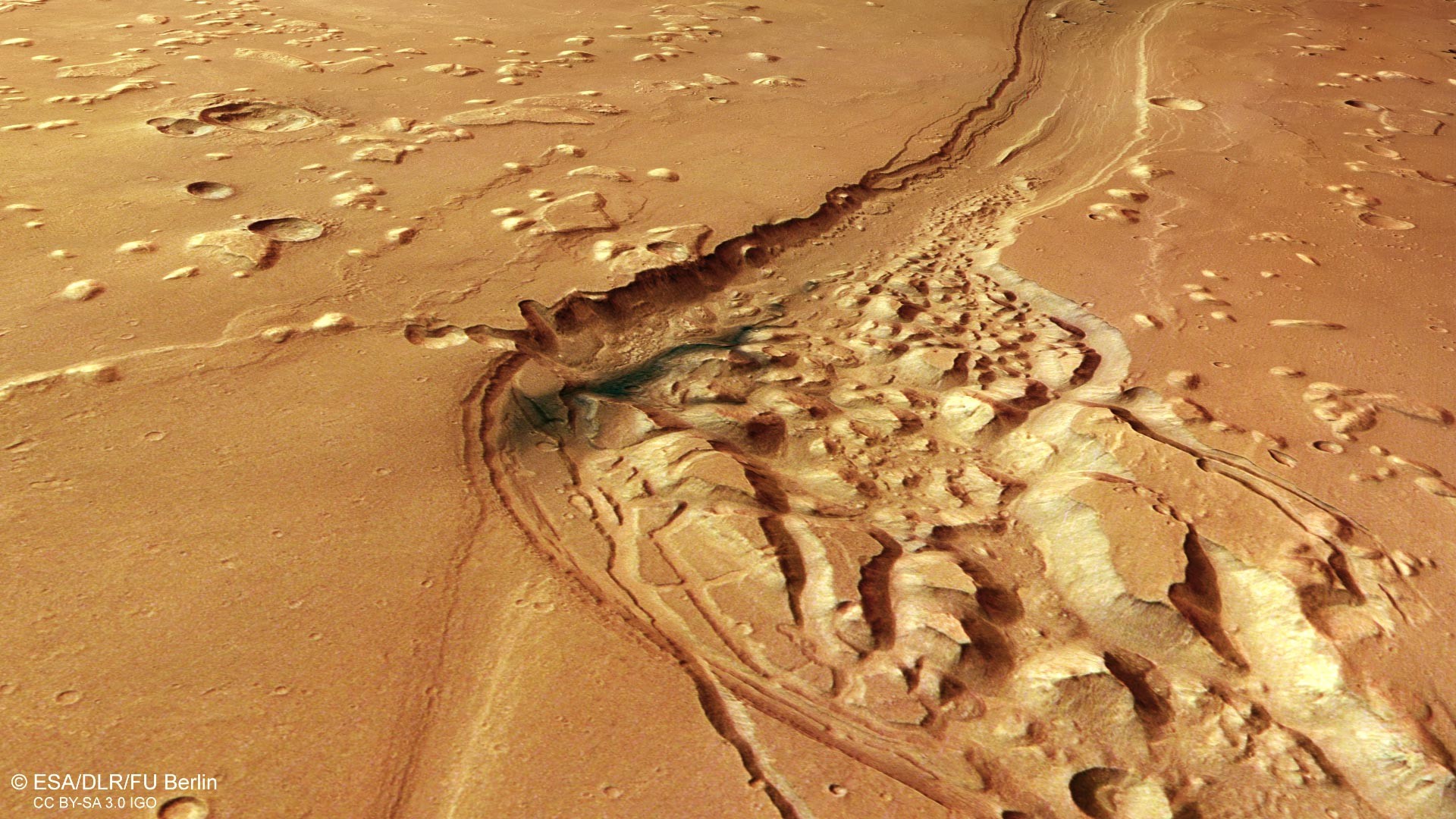
ESA’s Mars Express snapped some wild photos recently. Look closely at the Shalbatana Vallis. It’s not just a valley, really. It is a ghost.
A reminder that Mars was once wetter. Much wetter. The new images from the mission’s High Resolution Stereo Camera show a mess of craters and collapsed land. A chaotic landscape that screams “something big happened here.”
Where is this place?
Right near the equator. It stretches for roughly 1,301 kilometers. About as long as Italy.
The latest shots focus on the northern part of this channel. In October 2025? Wait, check your calendar. ESA released a video tour tracing this thing from start to finish. From the highlands of Xanthe all the way to Chryse Planitia below.
Water Raged Here
How did this happen? Science says floods. Massive, terrifying floods.
Around 3.5 billion years ago. Groundwater exploded upward. Bursting through the Martian crust like champagne corks in reverse.
The main channel enters from the left in the new photos. It curves north, disappearing off-frame. It is wide—10 kilometers wide—and deep. About 500 meters deep. But that is the current depth. It was probably deeper before.
Sediment filled it in over time. Nature’s janitorial service.
One dark blue-black patch in the rough area? That looks like volcanic ash. Martian winds blew it around. You can see the details best in the 3D perspective shots.
Did you ever see a landscape that looked like it had been dropped from orbit? This is it.
An Ocean That Isn’t There
Shalbatana is just one thread in a larger web of channels. It sits on the border between the cratered south and the smooth north.
To the right lies Chryse Planitia. One of the lowest points on the planet. Lots of these flood channels end there.
Many scientists think this low-lying area was once an ocean. Back when Mars had a thicker atmosphere and didn’t freeze its butt off overnight. Now it’s dry dust and cold wind.
Lava and Broken Ground
It’s not all water damage. The surrounding terrain is a geological buffet.
There’s chaotic terrain nearby. Jumbled blocks of rock and ridges. It looks like a jigsaw puzzle solved by a toddler. Why? Underground ice melted. The ground collapsed into the void left behind.
Mars Express has seen this stuff before—Pyrrhae Regio, Hydraotes Chaos, Aram Chaos. The planet loves its collapsing ground.
Craters dot the place. Some are fresh-looking, rimmed with debris. Others are faded ghosts, eroded by millennia of abrasion.
And the lava? Smooth patches suggest lava flows. When lava cools, it shrinks. It folds. Creases. They call them ‘wrinkle ridges’. Mesas poke out too—isolated hills standing where plateaus used to be. Billions of years of wind erosion whittling them down.
Twenty Years of staring at Red Dust
This wasn’t easy to get. The HRSC camera has been working for more than two decades. Launched in 2003. Still going.
Mapping Mars in 3D. In color. At incredible detail.
The camera came from Germany’s DLR. They handle the processing. Freie Universität Berlin crunched the data for these specific views.
We are still learning what that planet hides under its rust-colored skin. One flood channel at a time. The rest is silence.