




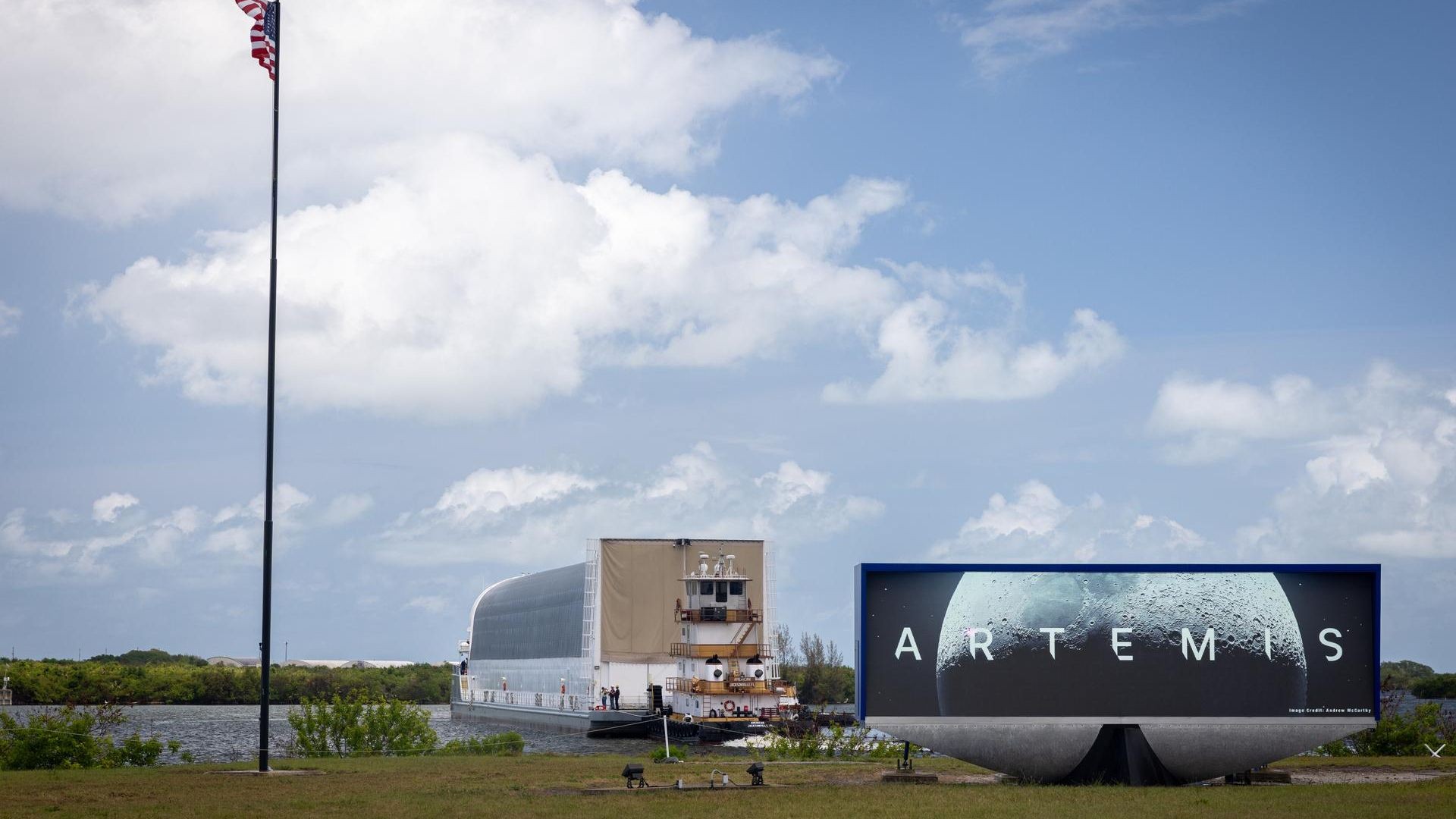
The heavy lifting for NASA’s next major lunar milestone has officially begun. On Monday, April 27, the upper 80% of the Space Launch System (SLS) core stage arrived at the Kennedy Space Center (KSC) in Florida, marking a critical step in the assembly of the rocket destined for the Artemis 3 mission.
From New Orleans to the Launchpad
The massive component completed a 900-mile (1,450 km) journey across the water via the Pegasus barge, traveling from NASA’s Michoud Assembly Facility in New Orleans.
Upon arrival, the hardware is being transferred to the Vehicle Assembly Building (VAB). There, technicians will begin the complex process of “mating” the core stage with its engine section. Once these components are joined, the assembly of the 212-foot-tall (64.6-meter) core stage will be complete.
Mission Profile: Testing the Gateway to the Moon
While the SLS is designed to propel humans toward the lunar surface, the upcoming Artemis 3 mission has a specific, orbital focus. Unlike previous missions that aimed directly for lunar landing, Artemis 3 will operate in Earth orbit.
The primary objective of this mission is to conduct high-stakes technical tests, specifically:
– Rendezvous and docking operations between the Orion capsule and lunar landers.
– Testing private-sector hardware, including SpaceX’s Starship and Blue Origin’s Blue Moon landers.
This phase is essential because the success of future moon landings depends entirely on whether these privately developed vehicles can safely connect with NASA’s Orion spacecraft in the vacuum of space.
Shifting Timelines and Future Outlook
The logistics of lunar exploration are notoriously complex, and the schedule reflects the challenges of integrating government and private technology. While NASA originally aimed for a mid-2027 launch, the timeline has shifted to late 2027.
This delay is a strategic move to provide additional development time for the two primary lander candidates—Starship and Blue Moon—to ensure they are flight-ready.
The roadmap for lunar return remains ambitious: If Artemis 3 successfully validates docking procedures in Earth orbit, NASA intends to launch Artemis 4 as early as 2028, which will aim to finally place astronauts on the lunar surface.
Summary
The arrival of the SLS core stage marks the transition from manufacturing to active assembly for the Artemis 3 mission. While the launch date has moved to late 2027 to accommodate lander development, this milestone brings NASA one step closer to testing the critical docking technologies required for permanent human presence on the Moon.