




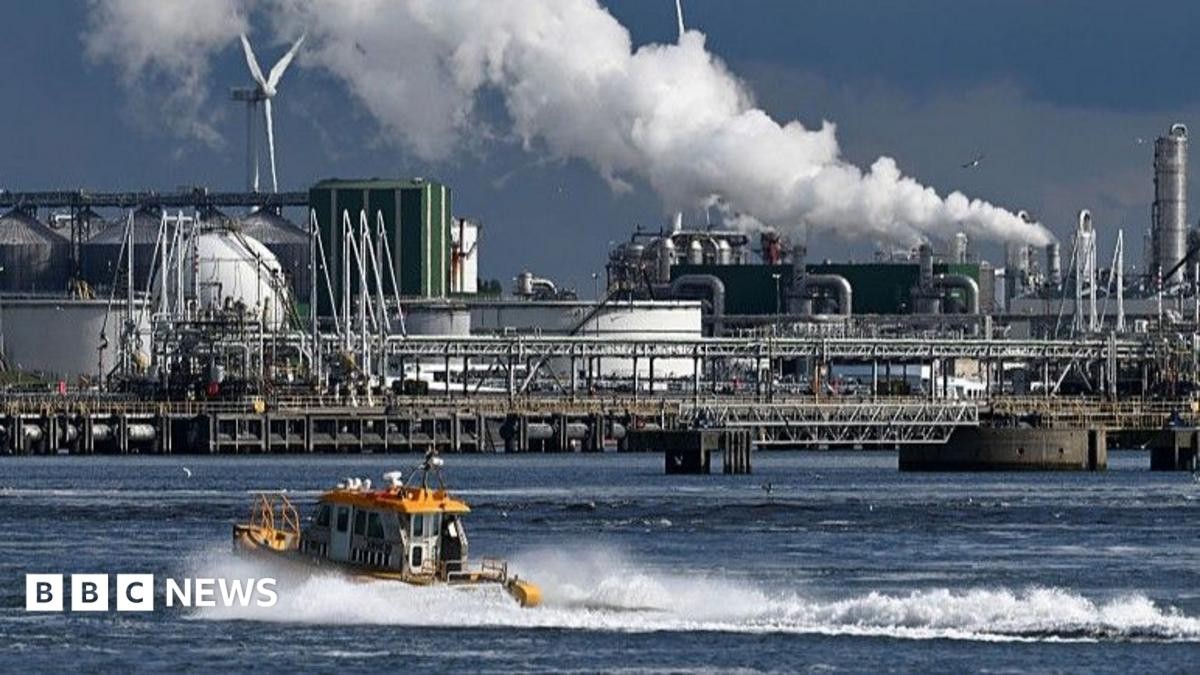
Looking out from the Hook of Holland, the horizon looks like a mechanical beast.
Steel cranes. Towering bulk carriers. Mountains of shipping containers stacked like toys. This is the Port of Rotterdam. The largest freight port in Western Europe.
It sits at the mouth of the Rhine and Meuser rivers on land wrestled back from the North Sea.
Scale matters here. By some metrics, Rotterdam moves as much cargo as every single port in the UK combined.
But beneath the logistics lies a heavier reality. Five refineries pump out hundreds of thousands of barrels of oil daily. One is Shell’s largest in Europe. A tight cluster of chemical plants supplies factories across the continent.
According to CE Delft research, the fossil fuels passing through these gates eventually produce roughly 600 million tonnes of CO2 annually.
Think about that. That dwarfs the emissions from Amsterdam’s Schiphol airport by many times.
A port built on dirt needs a clean exit.
This makes Rotterdam the ultimate test case. Can an industrial heart powered by fossil fuels ever become truly green?
The pressure is on.
The Lawsuit
An environmental group called Advocates for Future is suing.
Their argument is blunt. The Port Authority isn’t doing enough to phase out oil, gas, and coal. They want a concrete timeline. Not a promise. A plan.
The industrial cluster inside the port emits 29 million tonnes of carbon annually.
Mark van Dijk, the Authority’s external relations head, admits the scale. “It’s not good.”
That amount of pollution equals tens of thousands of round-trip flights between Amsterdam and Los Angeles.
The Plan
The Port Authority has goals. Ambitious ones.
They aim to cut their direct and purchased energy emissions by 90% between 2019 and 2030.
How?
- Building a hydrogen hub for fuel testing
- Installing onshore power cables so ships plug in rather than running idling engines
- Supporting bunkering of methanol and biofuels
In the short term? Carbon Capture and Storage.
“The Porthos project,” says van Dijk.
It pipes captured CO2 from industry into depleted offshore gas fields. Traps the problem underground.
But Maikel van Wissen of Advocates for the Future isn’t impressed. Standing in the wind, he argues a state-owned entity should do more than manage the decline. It should speed up the revolution.
“If you don’t have a plan you choose cheap short-term solutions,” van Wissen says.
He believes the port must use its influence to force the change. Otherwise industry will just leave.
The Power Problem
Here is the snag.
Most big polluters don’t answer to Rotterdam. Their headquarters are in Beijing. New York. London.
Shell moved its home base to the UK. Unilever left entirely.
“The sphere of influence is limited,” says Bettina Kampman of CE Delft.
Even if the Port Authority wants to change, infrastructure holds it back. New green projects need physical space. Electrifying heavy industry needs power.
Right now, the cables aren’t there.
“New developments need space. Electricity needs wires. That’s the bottleneck.”
Harry Geerlings, an Emeritus professor at Erasmus University, studies this daily.
He is skeptical any single port can force a global transition.
He points to the Emissions Trading System in Europe. Rules on sulphur.
When EU laws changed ships had to clean up their fuels or install scrubbers. China resisted at first. But when its vessels were blocked from Western ports compliance became mandatory.
Incentives work.
But loopholes exist. Many ships run dual engines.
Clean low-sulphur fuel enters European waters. Cheaper heavy fuel oil burns in the high seas once the ship is clear.
Geerlings notes the Port Authority wants to transition. Really wants to. But their revenue still depends on fossil fuels.
“It’s not a light switch.”
Geopolitics
The timing is ugly.
Across the Atlantic, Donald Trump doubts climate policy. He attacks wind power. He offers incentives for fossil fuels.
Rotterdam fears a brain drain of energy-intensive industry.
Why stay in the green strictures of Europe if cheaper, dirtier power waits elsewhere?
Advocates for Future argues the Port should be judged as a public company. Higher standards apply.
“We want a phase-out plan,” says van Wissen. “Not just a net-zero promise for 2050.”
It is a narrow disagreement.
On paper, both sides agree on the destination. Net zero around the middle of this century.
Mark van Dijk and Maikel van Wissen drive back towards the city. Forty-five minutes away from the sprawl.
The goal is the same. The timeline is the war.
Who has the patience?